
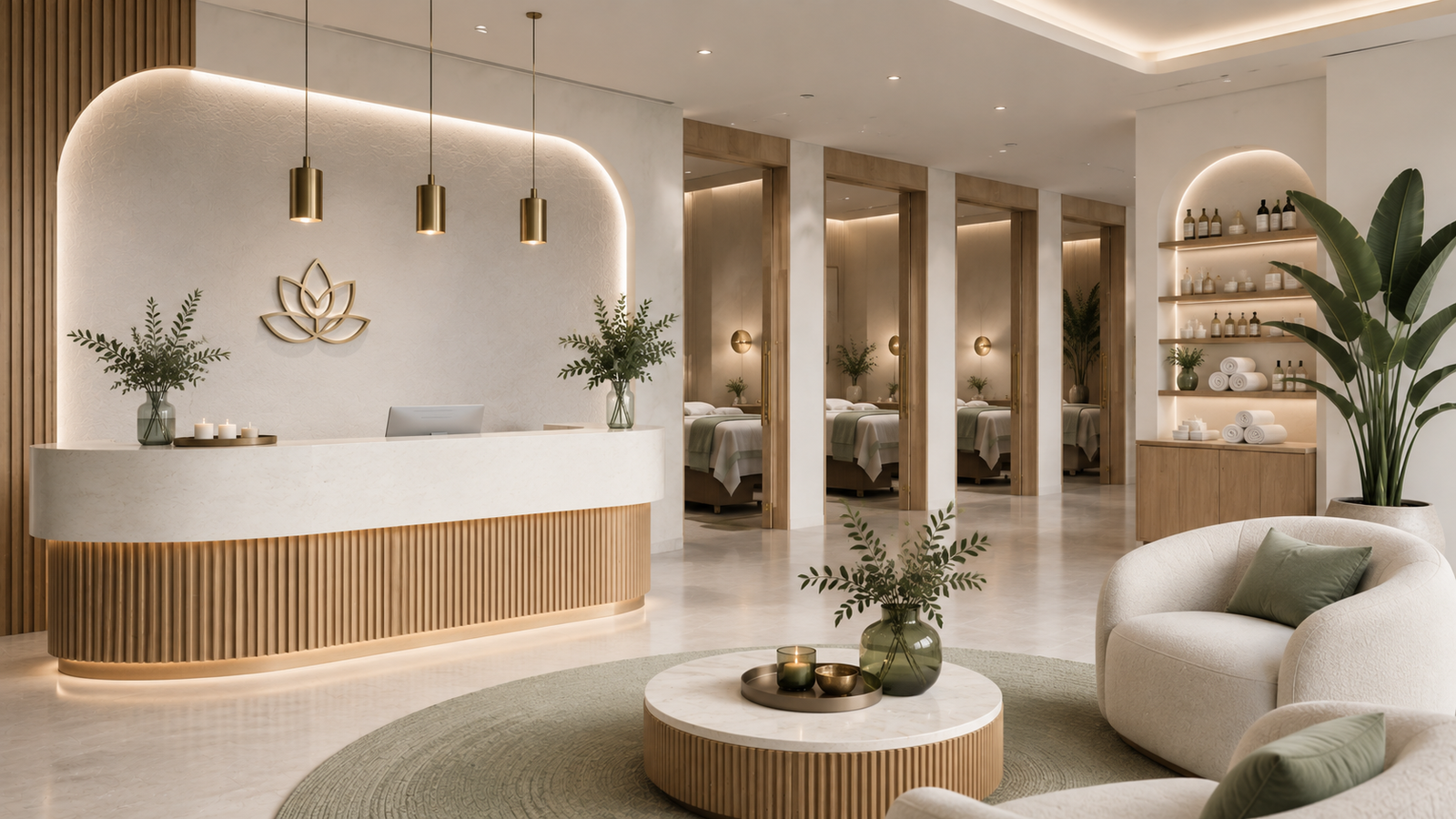
A spa that looks beautiful is not the same as a spa that works. Spa Interior Design in Dubai’s wellness market — one of the most competitive and fastest-growing in the region — the difference between a spa interior that builds a loyal client base and one that struggles with retention almost always comes down to design decisions that most owners do not think about until after opening.
This guide is written for spa owners, wellness centre operators, hotel spa directors, and anyone planning to open or renovate a spa or wellness facility in Dubai. It covers what spa interior design in Dubai actually involves, which design decisions directly affect client behaviour and revenue, what a quality fitout costs, how long it takes, and what to look for in a design partner who understands wellness environments specifically.
Why Spa Interior Design in Dubai Is a Commercial Decision, Not Just an Aesthetic One
Dubai’s wellness market has expanded significantly in recent years — driven by a health-conscious resident population, year-round tourist traffic, and a hospitality sector that increasingly uses spa and wellness facilities as a primary differentiator. The result is a market with strong demand and intense competition for the clients who want premium experiences.
In this environment, spa interior design in dubai performs three commercially important functions simultaneously:
- It creates the first impression that drives bookings. In Dubai’s wellness market, Google reviews, Instagram photography, and word-of-mouth referrals are the primary discovery channels. A spa interior that looks genuinely luxurious and distinctive generates the kind of content and conversation that fills booking calendars organically.
- It determines whether clients return. A guest who feels genuinely transported — away from the noise, the heat, and the pace of Dubai’s daily life — becomes a repeat client. A guest who feels they have visited a nice room does not. The design quality of the sensory experience, not just the treatment quality, is what drives retention in Dubai’s premium wellness market.
- It justifies premium pricing. The interior design of a spa communicates its positioning more immediately than any other signal. A space that feels considered, luxurious, and genuinely restful commands significantly higher treatment prices and membership fees than one that simply looks clean and tidy.
A well-executed luxury spa interior design in Dubai is infrastructure for commercial performance — not a cost to minimise.
The Design Elements That Drive Client Retention in Dubai Spas
Most spa design guides focus on what looks good in photography. The elements that actually drive client retention in Dubai’s wellness market are primarily about how the space feels — and they require specific design expertise to get right.
The Guest Journey — From Arrival to Departure
The most commercially important design decision in any spa interior design project is the guest journey — the sequence of spatial experiences from the moment a client enters to the moment they leave. Every transition matters: from the entrance to reception, from reception to changing facilities, from changing to the treatment corridor, from treatment to relaxation and recovery space, and from recovery to departure.
A well-designed guest journey builds anticipation before treatment and extends the emotional benefit after it. A poorly designed one — where clients navigate confusing corridors, encounter staff-only areas, or transition too abruptly from treatment back to the street — undermines the experience regardless of treatment quality.
Acoustic Design — The Most Overlooked Element
Noise is the single most common reason clients do not return to a spa in Dubai. A treatment room where mechanical noise from adjacent HVAC is audible, a relaxation lounge where sound bleeds from a neighbouring treatment room, or a reception area where staff conversations reach the changing room — each of these breaks the illusion of tranquility that clients are paying for.
Acoustic design in a spa environment requires specific attention at every stage: structural isolation between treatment rooms, acoustic treatment of relaxation and recovery spaces, careful HVAC specification and positioning, and acoustic sealing of all penetrations. This is significantly easier and cheaper to design correctly at the outset than to retrofit after opening.
Lighting Design — Therapeutic, Not Just Atmospheric
Lighting in a spa and wellness centre serves a different purpose from lighting in a restaurant or retail environment. The goal is not stimulation but regulation — supporting the nervous system’s transition from the alert state clients arrive in to the calm state that makes treatment effective and memorable.
This requires specific design decisions at every zone:
- Reception and transition spaces — warm, lower-intensity lighting that begins the decompression process from the moment of arrival
- Treatment rooms — controllable, dimmable, with the option to reduce to near-darkness where treatment protocols require; no exposed light sources in the client’s sightline when lying down
- Relaxation and recovery zones — the lowest light intensity in the facility; soft, indirect, and warm; zero ceiling lights directly above resting positions
- Wet areas and thermal facilities — waterproof, humidity-rated fixtures with colour temperature suited to the thermal experience being delivered
Material Selection — Sensory Quality Over Visual Quality
Materials in a spa environment are experienced with all five senses, not just sight. A timber floor that feels warm underfoot, a stone wall surface with genuine tactile depth, a towel storage area with a slight scent of cedar — these sensory details accumulate into an experience that clients remember and return for, even if they cannot articulate exactly why.
For luxury spa interior design in Dubai, the materials that consistently deliver this sensory quality include:
- Natural stone — marble, travertine, and limestone for wet areas and feature surfaces; provides genuine thermal mass and tactile quality that engineered alternatives cannot replicate
- Timber and wood — solid timber in sauna environments, timber veneer and engineered wood in dry zones; adds acoustic warmth as well as visual and tactile warmth
- Plaster and limewash finishes — handcrafted wall finishes that add depth and texture impossible to achieve with paint; particularly effective in treatment rooms and relaxation spaces
- Woven textiles and natural fabrics — linen, cotton, and natural fibre upholstery in relaxation zones; softens acoustic environments as well as visual ones
Material performance in Dubai’s climate must also be considered: humidity resistance in wet areas, UV stability in spaces with natural light, and thermal performance in zones with significant temperature differentials between air-conditioned interiors and outdoor environments.
Scent and Air Quality — Often Designed Last, Should Be First
The olfactory experience of a spa is one of the strongest drivers of emotional memory and brand association — and one of the most commonly treated as an operational decision rather than a design decision. The HVAC system, its filtration quality, its air change rate, the placement of diffusion points, and the integration of aromatherapy infrastructure are all design and engineering decisions that need to be made at the fitout stage, not purchased as plug-in devices after opening.
The Wet Area and Thermal Experience
Thermal facilities — sauna, steam room, hammam, cold plunge, hydrotherapy — are the highest-cost elements of any spa fitout in Dubai and the most technically demanding to design and execute correctly. They are also, increasingly, the primary reason clients choose one spa over another in Dubai’s competitive market.
Designing these spaces correctly requires coordination between the interior designer, MEP engineer, specialist equipment suppliers, and waterproofing consultants from the earliest design stages. The structural requirements for a hydrotherapy pool, the waterproofing specifications for a steam room, and the ventilation requirements for a sauna are all significantly easier to accommodate in a new fitout than to retrofit into a completed space.
Types of Spa and Wellness Spaces We Design in Dubai
The spa and wellness centre interior design category in Dubai covers a wide range of facility types — each with distinct design requirements, different target client profiles, and different commercial models.
Day Spas and Beauty Wellness Centres
Standalone day spas serving Dubai’s residential communities and business districts. These range from single-treatment-room boutique wellness studios to multi-room facilities with a full range of body and facial treatments. The design priority is creating an experience that feels genuinely premium relative to the treatment price point — justifying repeat visits and membership structures.
Hotel and Resort Spa Facilities
Spa facilities within hotel properties — ranging from hotel spas serving transient guests to destination spa facilities that attract local residents as well as hotel guests. Hotel spa design must deliver the visual quality expected of the property’s overall positioning while meeting the operational requirements of a high-throughput commercial spa environment.
Wellness and Longevity Centres
Dubai’s fastest-growing wellness category. Facilities combining traditional spa treatments with clinical wellness services — IV therapy, cryotherapy, hyperbaric oxygen, body composition analysis, and longevity-focused protocols. These spaces must balance the warmth and tranquility of a spa environment with the precision and cleanliness cues of a medical or clinical setting — a design tension that requires specific expertise to resolve well.
Private Residential Spa Spaces
Dedicated spa and wellness rooms within private villas — sauna, steam, plunge pool, treatment room, and relaxation zone designed as part of or adjacent to a residential fitout. Dubai’s luxury villa market has seen significant growth in home wellness facilities, driven by clients who want the spa experience without leaving their property.
Spa Fitout Costs in Dubai — 2026 Guide
Understanding realistic spa fitout costs in Dubai before approaching any contractor is essential. Spa and wellness fitouts are among the most technically complex commercial interior projects — and among the most commonly underbudgeted.
Day Spa and Beauty Wellness Centre
AED 600–1,000 per sq.ft — reception, changing facilities, treatment rooms, relaxation zone, wet area. A 300 sq.m day spa typically ranges from AED 1,800,000–3,000,000 for a quality fitout.
Premium Spa with Thermal Facilities
AED 900–1,500 per sq.ft — full spa with sauna, steam, hammam, or cold plunge in addition to treatment rooms and relaxation facilities. Thermal facilities add significant cost due to waterproofing, structural, MEP, and specialist equipment requirements.
Luxury Hotel Spa or Destination Wellness Centre
AED 1,200–2,000+ per sq.ft — highest specification materials, full thermal suite, hydrotherapy, bespoke joinery and feature elements throughout.
What drives cost in spa fitout projects:
- Waterproofing — wet areas require specialist waterproofing systems with flood testing before any finishing; this is where the most costly mistakes occur when underspecified
- Thermal facility equipment — sauna heaters, steam generators, chiller systems for cold plunge, hydrotherapy equipment: AED 150,000–500,000+ depending on scope
- MEP complexity — spa environments have demanding ventilation, drainage, and electrical requirements that exceed standard commercial fitouts significantly
- Acoustic treatment — structural isolation between treatment rooms, acoustic wall and ceiling systems throughout
- Natural stone and imported materials — the material quality expected in premium spa environments carries significant cost premium over standard commercial finishes
- Authority approvals — Dubai Civil Defence, DEWA, Dubai Municipality (health and safety for wet areas), DHA (for facilities with clinical services): AED 15,000–50,000+ depending on scope
The Spa Fitout Process in Dubai — What to Expect
Stage 1 — Brief and Concept
Before design begins, the commercial model must be clear: what services are being offered, at what price point, to what client profile, and with what membership or visit frequency target. A day spa designed for 45-minute express treatments serves different spatial requirements from a destination spa designed for half-day wellness programmes. The brief determines the design, not the other way around.
Stage 2 — Space Planning and Guest Journey Design
The spatial plan resolves the guest journey, treatment room count and configuration, staff circulation separate from client circulation, equipment room and plant room locations, storage, and the relationship between wet and dry areas. This stage requires early coordination with MEP engineers, particularly for facilities including thermal equipment.
Stage 3 — Concept Design and 3D Visualisation
The visual concept is developed — material palette, lighting approach, joinery and millwork, feature elements, and the sensory design of each zone — and presented as 3D renders. For spa environments, the renders should communicate atmosphere and feeling, not just visual appearance. Changes at this stage are inexpensive. Changes during fitout execution are not.
Stage 4 — Technical Design and Specialist Coordination
Detailed technical drawings, waterproofing specifications, MEP coordination, equipment schedules, and joinery drawings. Specialist coordination — with thermal equipment suppliers, waterproofing consultants, acoustic engineers — happens at this stage, not after construction begins.
Stage 5 — Authority Approvals
Spa and wellness fitouts in Dubai require approvals from Dubai Civil Defence, DEWA, Dubai Municipality for health and sanitation compliance, and your landlord or building management. Facilities with clinical or medical services require Dubai Health Authority (DHA) approval. Free zone facilities require additional authority approvals from the relevant free zone. Five Atelier manages the full approval process on behalf of clients.
Stage 6 — Fitout Execution
Waterproofing and structural works first, followed by MEP rough-in, plastering and rendering, tiling, joinery installation, lighting, and final finishes. Thermal facility equipment is installed and commissioned in coordination with the overall fitout programme. The sequence of works in a spa fitout is more critical than in most commercial fitout types — getting it wrong results in expensive rework.
Stage 7 — Commissioning, Snagging, and Handover
All systems — thermal equipment, lighting control, HVAC, audio — are commissioned and tested before the snagging inspection. Defects are rectified before handover. A spa that opens with unresolved snagging items generates negative first impressions in its most critical trading period.
Typical spa fitout timelines:
- Small day spa (under 150 sq.m) — 14–20 weeks from design sign-off
- Medium spa with thermal facilities (150–400 sq.m) — 20–30 weeks
- Large wellness centre or hotel spa (400 sq.m+) — 6–12 months
- Add 6–10 weeks for design development and authority approvals before construction begins
Common Mistakes in Dubai Spa and Wellness Fitouts
Underspecifying waterproofing
Waterproofing failure in a spa environment is catastrophic — causing structural damage, forcing closure, and requiring full demolition and reconstruction of finished areas. It is also among the most common causes of spa fitout failures in Dubai. Specifying and independently testing waterproofing systems before any finishing work proceeds is non-negotiable.
Treating acoustic design as optional
Sound bleeds between treatment rooms, audible mechanical noise, and voices carrying from reception to relaxation areas are among the most common causes of negative reviews in Dubai spas. Acoustic treatment is not decorative — it is functional infrastructure that is vastly cheaper to install correctly during fitout than to add retrospectively.
Selecting a general contractor without spa fitout experience
Spa fitouts involve specialist knowledge — waterproofing systems, thermal equipment coordination, steam room engineering, acoustic isolation — that a general contractor without specific experience will not have. The consequences of errors in these areas are significantly more serious and expensive than errors in standard commercial fitout work.
Designing the aesthetics before resolving the guest journey
A spa that looks beautiful in renders but requires clients to walk past the laundry room to reach treatment, or where staff movement intersects with client relaxation zones, will not perform commercially regardless of material quality. The spatial plan and guest journey must be resolved before aesthetic decisions are made — not the other way around.
How Five Atelier Approaches Spa and Wellness Centre Design
Every spa interior design project in Dubai we take on begins with understanding the wellness concept and the commercial model — not the aesthetic references. We want to know what treatments are being offered, what the target client profile is, what the pricing strategy is, and what the spatial and operational requirements are before we discuss materials or lighting.
From that foundation, we design guest journeys that build genuine tranquility, spaces that deliver sensory quality across every zone, and wellness centre fitouts in Dubai that perform commercially from opening day.
We manage the full process in-house — concept design, technical specification, specialist contractor coordination, authority approvals, fitout execution, and final commissioning. One team, one point of contact, full accountability from first consultation to handover.
Ready to Design Your Spa or Wellness Centre?
If you are planning a new spa or wellness centre in Dubai — or renovating an existing facility — and want to work with a studio that understands both the design and the operational demands of wellness environments, we would be glad to start the conversation.
Get in touch with Five Atelier Interiors →
Explore our spa and wellness centre interior design services, browse our completed hospitality and wellness projects, or learn more about our full hospitality interior design offering across Dubai.
Frequently Asked Questions
How much does a spa fitout cost in Dubai?
Spa fitout costs in Dubai range from AED 600–1,000 per sq.ft for a day spa without thermal facilities, AED 900–1,500 per sq.ft for a premium spa with sauna, steam, or hammam, and AED 1,200–2,000+ per sq.ft for a luxury hotel spa or destination wellness centre. Thermal facility equipment is typically priced separately at AED 150,000–500,000+ depending on scope. Five Atelier provides detailed, itemised quotes after an initial consultation and site assessment.
How long does a spa fitout take in Dubai?
A small day spa takes 14–20 weeks from design sign-off to handover. A medium spa with thermal facilities takes 20–30 weeks. A large wellness centre or hotel spa takes 6–12 months. Add 6–10 weeks for design development and authority approvals before construction begins.
What authority approvals are required for a spa in Dubai?
Spa fitouts in Dubai typically require Dubai Civil Defence approval, DEWA clearance, Dubai Municipality approval for health and sanitation compliance, and landlord or building management NOC. Facilities offering clinical wellness services — IV therapy, cryotherapy, aesthetic treatments — require Dubai Health Authority (DHA) approval. Five Atelier manages the full approval process on behalf of clients.
What is the most important design element in a spa interior?
The guest journey — the sequence of spatial experiences from arrival to departure — is the most commercially important design element in any spa. Acoustic design is the most commonly underestimated. Lighting design has the strongest impact on how clients feel during and after treatment. All three need to be resolved together at the earliest design stage, not addressed sequentially or as afterthoughts.
Can Five Atelier design spa facilities with thermal equipment like saunas and hammams?
Yes. Five Atelier designs and delivers spa fitouts in Dubai including thermal facilities — sauna, steam room, hammam, cold plunge, and hydrotherapy — coordinating with specialist equipment suppliers and MEP engineers from the earliest design stages. Thermal facility design requires specific technical knowledge of structural, waterproofing, MEP, and equipment integration requirements that is built into our process from the outset.
What makes a spa interior design successful commercially in Dubai?
Commercial success in Dubai’s spa market is driven by repeat visits and membership retention rather than one-time bookings. The design elements that most directly affect these metrics are: acoustic quality that creates genuine tranquility, a guest journey that builds the wellness experience from arrival to departure, lighting design that supports the transition from an alert to a calm state, and material quality that communicates the price point being charged. A spa that delivers on all four consistently outperforms one that excels visually but underperforms sensorially.
Does Five Atelier design private home spa spaces as well as commercial facilities?
Yes. Five Atelier designs private residential spa and wellness spaces within luxury villas across Dubai — dedicated spa rooms, sauna and steam facilities, plunge pools, treatment rooms, and relaxation zones designed as part of a residential fitout. The design approach for private spa spaces applies the same principles as commercial wellness design — guest journey, acoustic quality, lighting, and material sensory experience — at a residential scale and budget.
What is the difference between a spa fitout and a standard commercial fitout?
Spa fitouts involve several specialist requirements that go beyond standard commercial fitout scope: waterproofing systems for wet areas and thermal facilities, acoustic isolation between treatment rooms, specific MEP requirements for sauna, steam, and hydrotherapy equipment, health authority compliance for client wellness services, and sensory design expertise across lighting, materials, and spatial experience. Working with a studio that has specific spa fitout experience is significantly more important in this category than in most commercial fitout types.
Five Atelier Interiors is a luxury interior design and fitout studio in Dubai, delivering bespoke residential, commercial, and hospitality projects across the UAE.