
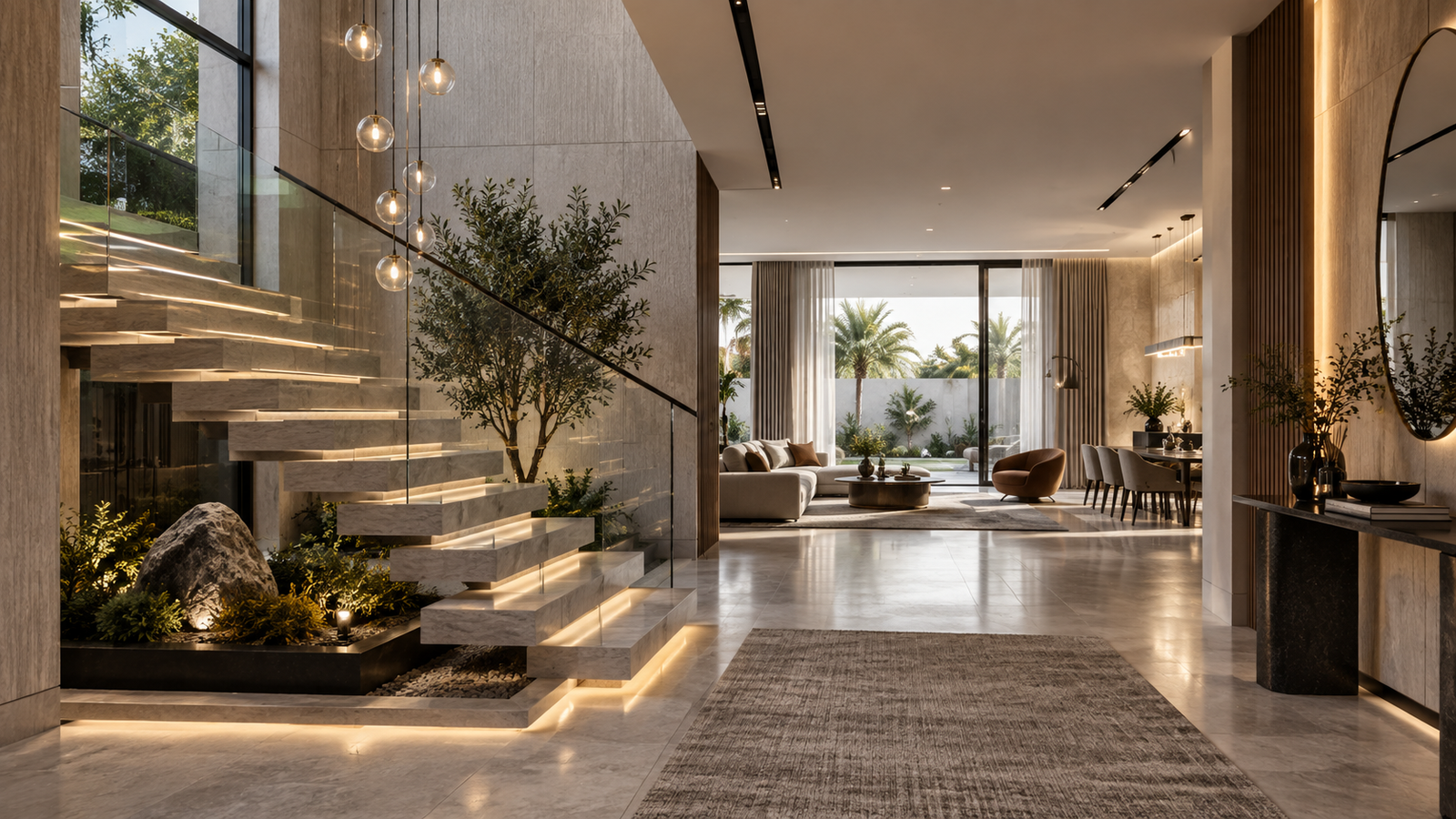
Dubai and the wider UAE offer some of the most ambitious residential environments in the world — from ultra-luxury villas on Palm Jumeirah and Emirates Hills to high-rise penthouses in Downtown Dubai, waterfront apartments in Dubai Marina, and family homes across the growing communities of Dubai Hills, Arabian Ranches, and Mohammed Bin Rashid City. The residential market here is diverse in scale, diverse in property type, and diverse in the expectations of the people who live in it.
Residential interior design in Dubai and the UAE has evolved significantly in recent years — moving beyond surface-level decoration and toward a more considered approach that balances design quality, material performance, practical function, and long-term value. The homeowners investing in quality interiors today are not simply making their homes look better. They are making them work better for how their families actually live.
This guide covers everything you need to know about residential interior design in Dubai — the full scope of what it involves, what it costs across different property types, how the process works from first conversation to handover, what makes Dubai’s residential market unique, and how to find the right design partner for your home.
What Residential Interior Design in Dubai and the UAE Actually Involves
Interior design is a broader and more structured service than most homeowners expect when they first begin exploring it. A full residential interior design service in Dubai typically covers the following:
- Space planning — resolving how every room is laid out for daily life, not just for photographs
- Concept design — establishing the design direction, material palette, colour language, lighting approach, and the key design moments that give the home its identity
- 3D visualisation — photorealistic renders that let you see the finished result before any physical work begins
- Material and finish specification — selecting and coordinating every surface, finish, and material throughout the home
- Custom joinery design — wardrobes, kitchen cabinetry, media walls, built-in storage, and wall panelling designed specifically for your space
- Lighting design — a layered lighting plan that goes far beyond switching overhead lights on
- Furniture specification and procurement — sourcing and coordinating all furniture, soft furnishings, and accessories
- Authority approvals — community NOC, DEWA, DCD, and building management approvals as required by your property type and community
- Full fitout execution — managing construction, trades, joinery production, and quality control through to completion
- Styling and handover — the final installation of art, accessories, and soft furnishings that complete the design
Some studios offer all of the above under a single turnkey contract. Others offer design only and expect you to manage execution separately. Understanding which model a studio operates before you engage them prevents the most common source of project frustration in Dubai’s residential design market.
What Makes Residential Interior Design in Dubai Unique
Designing homes in Dubai involves specific considerations that distinguish it from residential design markets elsewhere — and that any quality residential interior designer in Dubai needs to understand and design for from the outset.
The UAE climate and material performance
Dubai’s climate creates specific material performance requirements that generic design guides consistently overlook. Extreme UV exposure through floor-to-ceiling glazing degrades fabrics, fades timber finishes, and causes certain stones to lose their polish faster than in temperate climates. The significant temperature differential between heavily air-conditioned interiors and outdoor heat creates humidity issues in transition zones. Fine airborne desert dust settles on every horizontal surface and in open-weave textiles.
Material selection for residential interior design in the UAE needs to account for all of these — not as limitations but as design parameters that shape which materials are chosen and how they are specified. Quartz and sintered stone over unsealed marble for high-use surfaces. Engineered timber over solid wood for flooring in humid-adjacent zones. Performance fabrics in family living areas. UV-stable finishes on any joinery near significant glazing.
Community and developer restrictions
The majority of Dubai’s residential properties — villas and apartments alike — sit within master-planned communities governed by developer guidelines. Emaar, Nakheel, DAMAC, Meraas, Trakhees, and building management offices each have their own NOC processes, structural requirements, and modification restrictions. Understanding what is and is not permitted in your specific community before the design process begins prevents costly design work that cannot be executed and avoids the even more costly consequence of unauthorised work being discovered mid-project.
Indoor-outdoor living
Dubai’s climate means that outdoor spaces — terraces, pool decks, covered seating areas, and gardens — are actively used extensions of the home for a meaningful part of the year. The best residential interior design in Dubai treats the indoor-outdoor relationship as a central design consideration — with material continuity between internal and external zones, considered sight lines from living areas to outdoor spaces, and outdoor areas designed with the same level of detail as the interior.
The diversity of property types
Dubai’s residential market spans a wider range of property types than almost any comparable market — from 400 sq.ft studio apartments to 15,000 sq.ft custom villas, from developer-standard apartments to architecturally significant private residences. Each property type has distinct design requirements, different spatial challenges, and different client expectations. The studio you choose should have demonstrable experience with projects comparable in type and scale to yours.
Residential Property Types — Design Priorities by Category
Villas and Private Residences
Villa interior design is the most comprehensive residential design challenge — encompassing multiple floors, formal and informal living zones, master suite, family bedrooms, kitchen, outdoor terraces, garden, pool area, and often staff quarters and home office spaces. The design must create coherence across all of these spaces while serving the specific functional needs of each. Key priorities: a strong design concept that runs consistently from entrance to garden, custom joinery that maximises storage without compromising spatial quality, layered lighting throughout, and outdoor spaces designed as genuine extensions of the home rather than afterthoughts.
Apartments and Penthouses
Apartment interior design in Dubai is primarily a challenge of spatial intelligence — making developer floor plans, which are frequently optimised for sales brochures rather than daily living, work well for the people who actually live in them. Custom joinery, considered furniture scale, visual continuity between open-plan zones, and a layered lighting redesign are the four investments that most dramatically transform how a Dubai apartment feels to inhabit. For penthouses, the design ambition typically matches villa level — the scale demands it, and the client expectation requires it.
Holiday Homes and Short-Term Rental Properties
Residential interior design for Airbnb and holiday home properties in Dubai requires a specific commercial lens. The design must create a genuine sense of luxury and distinction that translates to strong listing photography, high occupancy, and five-star reviews — while using materials and finishes durable enough to withstand frequent turnovers without losing visual quality. The entrance, the living room hero shot, the bedroom comfort, and the bathroom finish are the four design priorities that most directly affect short-term rental performance in Dubai’s competitive market.
New Properties and Handover-Ready Fitouts
Homeowners taking possession of a new property in Dubai typically face two choices: accept the developer-standard specification and personalise it gradually, or commission a full fitout before moving in. A full pre-move-in fitout is almost always more cost-effective than retrofitting a lived-in property — trades can work without disrupting daily life, joinery can be installed in sequence, and the design can be executed as a cohesive whole rather than assembled piecemeal over years.
Residential Interior Design Styles in Dubai in 2026
Dubai’s residential design aesthetic has matured significantly. The direction across the UAE’s most considered home interiors in 2026 is away from statement opulence and toward something more personal, more considered, and more enduring.
Warm Contemporary
The most widely requested design direction for Dubai and UAE homes in 2026. Warm neutral palettes — sand, greige, soft taupe — combined with natural stone, timber veneer, woven textiles, and matte joinery finishes. Layered lighting at warm colour temperatures. The result is a home that feels sophisticated, calm, and genuinely comfortable — designed for how people live rather than how interiors photograph. It ages well, adapts easily to personalisation over time, and works across property types and scales.
Biophilic and Nature-Led Design
Growing significantly in Dubai’s residential market. Natural materials — travertine, limestone, rattan, solid timber — combined with indoor planting, maximised natural light, and organic forms in furniture and joinery. Particularly effective in villas with garden access and in apartments with significant glazing, where the connection to natural light and materials creates a restorative quality that purely designed interiors cannot achieve. In a city where most daily life is spent in air-conditioned interiors, the biophilic approach addresses a genuine sensory need.
Modern Luxury
Clean architectural lines, premium imported materials, strong spatial geometry, and a restrained palette that relies on material quality and precision of execution rather than decorative layering. Effective in properties with strong architecture or significant glazing, where the interior concept extends and complements what the building already offers. The most demanding design direction in terms of execution quality — because there is nowhere to hide imprecision when the design is resolved entirely through material and detail.
Classic Luxury
Timeless rather than trend-driven. Symmetrical layouts, traditional architectural detailing, richer material palettes — marble, brass, velvet, dark timber — and furniture with classical proportions. Particularly requested in Emirates Hills and older Jumeirah villas where the architecture suits a traditional aesthetic. Done with discipline and restraint, classic luxury interiors are the most enduring — they reference a tradition rather than a moment, and they do not date.
Residential Interior Design Costs in Dubai and UAE — 2026
Cost is the question that every homeowner asks first, and the one most often answered vaguely. Here are realistic benchmarks for residential interior design in Dubai and the UAE based on current market rates.
Studio and 1-bedroom apartment
AED 80,000–200,000 for a full fitout — custom joinery, material upgrades, lighting redesign, and furniture specification.
2–3 bedroom apartment
AED 180,000–500,000 for a comprehensive fitout — full joinery throughout, material specification, lighting design, and complete furniture procurement.
Penthouse
AED 400,000–1,200,000+ — premium materials, fully bespoke joinery, smart home integration, and high-end furniture procurement.
Mid-range villa fitout
AED 450–750 per sq.ft — premium materials, custom joinery, full lighting design. A 4,000 sq.ft villa ranges from AED 1,800,000–3,000,000.
Luxury villa fitout
AED 750–1,500+ per sq.ft — imported materials, fully bespoke joinery and furniture, smart home integration, and the highest level of finish throughout.
What drives cost up
- Custom joinery — typically 40–55% of any residential fitout budget; the single largest cost driver and quality differentiator
- Imported materials — Italian stone, European sanitaryware and fixtures, bespoke hardware
- Smart home integration — lighting control, climate automation, AV: AED 20,000–150,000+
- MEP modifications — rewiring, replumbing, new AC systems, lighting circuit additions
- Authority approvals — community NOC, DEWA, DCD, building management: AED 5,000–25,000+
The Residential Interior Design Process — What to Expect
Stage 1 — Initial Consultation and Site Visit
The first conversation is about understanding how your household actually lives — daily routines, family dynamics, how each room is used, what is not working in the current space, and what a successful project means for you specifically. The site visit assesses the existing condition, natural light, spatial opportunities, and any constraints from the community, building, or structure.
Stage 2 — Concept Design and Visualisation
The design direction is established — material palette, spatial strategy, lighting concept, joinery language, and the key design moments that will define the home. Presented as mood boards and 3D renders so the vision can be seen and approved before any physical work begins. The most important principle: changes at render stage are inexpensive. Changes during construction are not.
Stage 3 — Design Development and Full Specification
The concept is developed into a complete technical package — detailed floor plans, elevations for every space, full joinery drawings, material schedules, lighting design, electrical layouts, and furniture specifications. This is what gets built. The more complete this package, the fewer surprises during construction and the more accurately the project can be costed.
Stage 4 — Authority Approvals
Community NOC, DEWA approvals for electrical modifications, DCD sign-off for fire safety changes, and building management approvals as applicable. A reputable residential interior design studio in Dubai manages this process entirely on your behalf — you should not need to engage with authorities directly.
Stage 5 — Fitout Execution
Construction, MEP works, waterproofing, joinery installation, tiling, flooring, lighting, and finishes — managed by the studio’s in-house project management team with consistent site presence and quality control throughout.
Stage 6 — Styling and Handover
Furniture installation, soft furnishings, art, accessories, and lighting commissioning. We hand over a finished, move-in ready home — not a construction site with a list of outstanding items.
Typical residential interior design timelines in Dubai:
- Single room renovation — 3–6 weeks
- Full apartment fitout — 8–16 weeks
- Full villa fitout — 4–7 months
- Add 2–4 weeks for design development and 1–6 weeks for authority approvals before construction begins
Communities We Work In Across Dubai and the UAE
Five Atelier delivers residential interior design across Dubai and the UAE — every district, community, and free zone. Some of the areas we most frequently work in:
- Palm Jumeirah — villas, apartments, and holiday homes; Trakhees approval process; the highest specification residential market in Dubai
- Emirates Hills and Jumeirah — large villas and private residences across Dubai’s established luxury villa communities
- Downtown Dubai — penthouses and premium apartments in Dubai’s most iconic address
- Dubai Marina and JBR — waterfront apartments and holiday homes across a range of scales
- Dubai Hills Estate and MBR City — villas and townhouses in Dubai’s growing master-planned luxury communities
- Business Bay — residential and mixed-use apartments in Dubai’s commercial core
- Arabian Ranches, Jumeirah Park, and Jumeirah Islands — family villa communities across a range of scales and specifications
- JVC and JVT — apartments and townhouses with strong demand for quality fitout
We also take selected projects across the wider UAE — Abu Dhabi, Sharjah, and other emirates. For specific enquiries outside Dubai, please get in touch directly.
How to Choose a Residential Interior Design Studio in Dubai
The quality gap between interior design companies in Dubai and the UAE is significant. The same budget can produce radically different outcomes depending on who you work with. Here is what to evaluate:
- Completed projects in your specific property type — a studio with a strong villa portfolio is not automatically the right choice for a penthouse apartment; ask specifically for completed projects similar in type and scale to yours
- Real photography of completed work — renders show intent; photography shows execution. If a studio’s portfolio is primarily renders, ask why
- In-house execution — does the studio design and build under one contract, or does it hand construction to a separate contractor? In-house execution means one team and one point of accountability from first meeting to handover
- Experience with your specific community’s approval process — a studio experienced in Palm Jumeirah villas understands Trakhees approvals; one that primarily works in apartments may not
- Transparent, itemised pricing — a detailed cost breakdown rather than a lump sum; costs that are vague at quote stage almost always grow during the project
- How they handle the first consultation — a good residential interior design studio listens before it proposes; one that arrives with a presentation before it has heard your brief is not approaching your project with the right level of attention
How Five Atelier Approaches Residential Interior Design
Every residential interior design project in Dubai we take on starts with understanding how your household actually lives — not a presentation of our preferred aesthetic. Before we discuss materials or lighting, we want to understand your daily routines, what is not working in the current space, what your budget is, and what a successful project looks like for your family specifically.
From that understanding, we develop layouts that genuinely work, concepts that are specific to your home and your life, and specifications that deliver on the design intent for years after handover — not just on the day of completion.
We manage the entire process in-house — concept design, technical specification, joinery design and production, authority approvals, fitout execution, and final styling. One team, one point of contact, full accountability from first meeting to handover.
Ready to Start Your Residential Interior Design Project?
If you are planning a residential interior design project in Dubai or the UAE — whether it is a full villa fitout, an apartment renovation, or a single room that has never felt right — we would be glad to start the conversation.
Get in touch with Five Atelier Interiors →
Browse our completed residential projects, explore our full residential interior design services, or learn more about specific services including kitchen design, bathroom design, and bedroom design across Dubai and the UAE.
Frequently Asked Questions
What does residential interior design in Dubai cost?
Residential interior design costs in Dubai range from AED 80,000–200,000 for a studio or 1-bedroom apartment fitout to AED 750–1,500+ per sq.ft for a luxury villa. A full 3-bedroom apartment fitout typically costs AED 300,000–650,000. A full villa fitout ranges from AED 1,800,000 for a mid-range specification to AED 5,000,000+ for an ultra-luxury bespoke project. Five Atelier provides detailed, itemised quotes after an initial consultation and site visit.
How long does residential interior design take in Dubai?
A single room renovation takes 3–6 weeks. A full apartment fitout takes 8–16 weeks. A full villa fitout takes 4–7 months. Add 2–4 weeks for design development and 1–6 weeks for authority approvals depending on community and scope.
Do I need authority approvals for residential interior design in Dubai?
For most modifications beyond purely cosmetic changes, yes. Structural works, MEP modifications, and any works in master-developer communities require community NOC approvals. DEWA approval is needed for electrical modifications. DCD approval is needed where fire systems are affected. Five Atelier assesses approval requirements during the design stage and manages the full process on behalf of clients.
What is the best interior design style for Dubai and UAE homes in 2026?
Warm contemporary — combining warm neutral palettes, natural stone and timber, matte joinery finishes, and layered lighting — is the most widely requested design direction for Dubai and UAE homes in 2026. Biophilic and nature-led design is the fastest-growing direction. The most enduring approach is always the one that reflects how the specific household lives rather than what is fashionable in a given year.
What materials work best for residential interiors in Dubai?
Quartz and sintered stone for kitchen and bathroom countertops — more durable than marble in Dubai’s conditions. Engineered timber flooring — more stable than solid wood in Dubai’s humidity differentials. Performance fabrics in family living areas. UV-stable joinery finishes in rooms with significant direct sunlight through glazing. Natural stone — travertine, marble, limestone — for feature applications where visual quality takes priority and maintenance is accepted.
Can I live in my home during a residential interior design project?
For single-room or phased renovations it is often possible. For a full home renovation or fitout — particularly involving MEP works, structural changes, or wet area demolition — vacating the property for the duration is strongly recommended. Five Atelier advises on phasing options during the initial consultation based on the specific project scope.
Does Five Atelier work on residential projects outside Dubai?
Five Atelier’s primary market is Dubai, where we work across all communities and districts. We also take selected residential projects across the wider UAE — Abu Dhabi, Sharjah, and other emirates. For specific enquiries about projects outside Dubai, please get in touch directly and we will advise on availability and process.
What is the difference between a residential interior designer and a fitout company in Dubai?
A residential interior designer handles the creative and planning process — concept development, space planning, material selection, and 3D visualisation. A fitout company handles physical execution — construction, joinery, tiling, and installation. Five Atelier is both — a design-led studio that manages the full process from initial concept through to final handover under one contract, with one team and one point of accountability throughout.
Five Atelier Interiors is a luxury interior design and fitout studio delivering bespoke residential and commercial projects across Dubai and the UAE.