
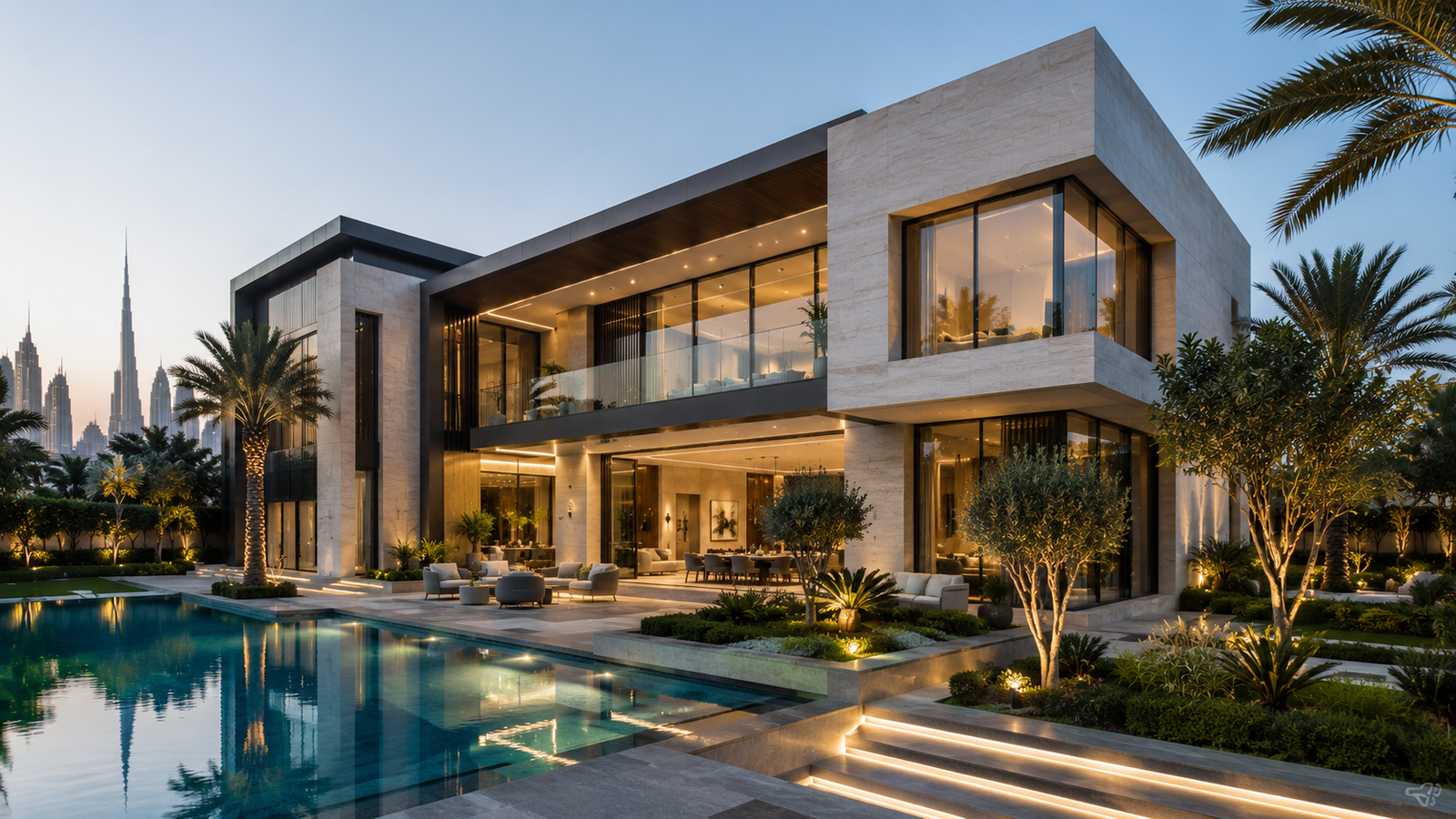
Designing the interior of a Dubai villa is a different challenge from designing any other residential property. The scale is different — villas here range from 3,000 to 15,000+ square feet across multiple levels, with expansive living zones, private outdoor spaces, staff quarters, and domestic functions that need to coexist seamlessly. The expectations are different — Dubai’s villa market represents some of the highest residential design standards in the world. And the practical realities are different — UAE climate, community regulations, and authority approval requirements all shape what is possible and what needs to be planned for from the outset.
This guide covers everything Dubai villa owners need to know about villa interior design in Dubai — what the process involves, what it costs, which design decisions matter most, how Dubai’s climate affects material choices, and what to look for in a design studio that can deliver at this level.
What Makes Villa Interior Design in Dubai Different
Dubai villas have specific design requirements that distinguish them from residential projects elsewhere — and from apartment projects within Dubai itself.
Scale and spatial complexity
A Dubai villa interior typically encompasses a ground floor with formal reception, family living, and kitchen zones; upper floors with master suite, family bedrooms, and study spaces; staff quarters; outdoor terraces, garden, and pool areas; and often a dedicated entertainment or wellness space. Designing all of these spaces as a coherent whole — with a consistent design language and considered transitions between zones — requires a different level of planning and coordination than smaller residential projects.
The indoor-outdoor relationship
Dubai’s climate means that outdoor living spaces — terraces, pool decks, garden areas, covered seating — are active extensions of the home for a significant part of the year. The best villa interior designs in Dubai treat the indoor-outdoor relationship as a central design consideration rather than an afterthought. Material continuity between indoor and outdoor zones, considered sight lines from internal living spaces to the garden and pool, and covered outdoor spaces that extend the living area meaningfully are all design decisions that define the quality of the overall result.
Community and developer requirements
Most Dubai villa communities are governed by master developer guidelines that restrict what can be modified and require approval before any work begins. Emaar, Nakheel, DAMAC, Meraas, Trakhees, and other developers each have their own NOC processes, structural requirements, and design guidelines. A studio experienced in Dubai villa design will already know the requirements for the community your villa is in — saving significant time and preventing the costly mistake of commencing work without the necessary approvals.
Climate performance
Dubai’s climate — extreme heat, strong UV exposure, significant humidity, and fine airborne dust — affects how every material in a villa interior performs over time. Material selection for a Dubai villa needs to account for UV stability near floor-to-ceiling glazing, humidity resistance in wet areas and outdoor-adjacent zones, dust accumulation on surfaces and in fabrics, and thermal comfort in spaces that transition between heavy air conditioning and outdoor heat. These are not aesthetic considerations — they are performance requirements that determine whether a beautiful interior still looks and functions well three years after completion.
Villa Interior Design Styles in Dubai — What Works in 2026
Dubai’s villa design aesthetic has matured significantly in recent years. The direction in 2026 is away from ostentatious display and toward considered restraint — interiors that feel genuinely luxurious through material quality, spatial intelligence, and design precision rather than through excess or grandeur for its own sake.
Warm Contemporary
The most requested design direction for Dubai villas in 2026. Warm neutral palettes — sand, greige, soft taupe — combined with natural stone, timber, and woven textiles. Handleless joinery in matte finishes. Layered lighting with warm colour temperatures throughout. The result is a home that feels sophisticated and calm without feeling cold or clinical. This style photographs beautifully, ages well, and translates across different room types and scales without losing coherence.
Modern Luxury
Clean architectural lines, premium imported materials, strong spatial geometry, and a restrained material palette that relies on quality rather than quantity for its impact. Modern luxury villa interiors in Dubai use stone, metal, and glass with precision — the design is resolved in the details and the material combinations rather than in decorative layering. This direction is particularly effective in villas with strong architecture or significant glazing, where the design concept complements and extends what the building envelope already offers.
Biophilic and Nature-Led
Growing strongly in Dubai’s villa market. Natural materials — travertine, limestone, solid timber, rattan — combined with indoor planting, living walls, maximised natural light, and organic forms in furniture and joinery. The goal is a home that feels genuinely restorative — where the quality of the sensory environment supports daily wellness rather than simply impressing visitors. Particularly effective in villas with garden access and strong indoor-outdoor connection.
Classic Luxury
Timeless rather than trend-driven. Symmetrical layouts, traditional architectural detailing, rich material palettes — marble, brass, velvet, dark timber — and furniture with classical proportions. Less common in new builds but highly requested in older Emirates Hills and Jumeirah villas where the architecture suits a more traditional aesthetic. Done well, classic luxury villa interiors in Dubai are the most enduring — they do not date because they are not referencing a moment.
The Design Decisions That Define a Dubai Villa Interior
The entrance and arrival experience
The entrance of a Dubai villa sets the tone for every space that follows. A well-designed entrance — considered flooring material, double-height ceiling treatment, considered lighting, and a view through to the main living space or garden — communicates the quality of the whole home in the first 10 seconds. This is the space where the design concept needs to be most clearly and confidently expressed. It is also, consistently, one of the most underinvested spaces in Dubai villa interiors.
The kitchen as a design anchor
In Dubai’s modern villas, the kitchen is increasingly open to the family living zone — visible, social, and as much a design statement as the living room. The back wall of the kitchen, where the hob typically sits, is a permanent backdrop to the family space and needs to be designed as one. Custom joinery that extends from floor to ceiling, a well-considered island that serves as both a prep surface and a social anchor, and material choices that complement the living zone palette are the decisions that determine whether the kitchen feels like a natural part of the home or a separate room that was pushed open.
The master suite
The master bedroom, dressing room, and bathroom suite in a Dubai villa often represent 20–25% of the total residential floor area. Designing these spaces with the same considered approach as the formal reception areas — coherent material palette, considered joinery, layered lighting, and genuine attention to how the space feels to inhabit rather than just to photograph — is what distinguishes a truly well-designed villa from one that prioritises public spaces at the expense of private ones.
Lighting throughout
Developer-supplied villa lighting is almost always inadequate — typically a single overhead circuit per room that produces flat, unflattering light at the wrong colour temperature. Designing a comprehensive lighting scheme for a villa — ambient, task, and accent layers in every room, controlled independently, at warm colour temperatures — is one of the highest-return investments in any luxury villa interior design in Dubai. It transforms how every space feels during the evening hours and significantly enhances the visual quality of materials and finishes that would otherwise read flat under overhead light.
Smart home integration
Smart home systems — lighting control, climate automation, audio-visual integration, security, and window treatment control — are increasingly a baseline expectation in Dubai villas above a certain value threshold. The critical design decision is not which system to use but how to integrate it — technology should be felt, not seen. Visible switches, exposed cabling, and branded keypads on every wall undermine the design intent regardless of how well the system performs. Smart home infrastructure needs to be specified and coordinated at the design stage, not added as an afterthought during fitout.
Materials for Villa Interiors in Dubai — What Performs and What to Avoid
Stone and surfaces
- Travertine — a defining material of Dubai villa interiors in 2026; warm, textural, and genuinely distinctive; requires sealing but rewards the maintenance with unmatched visual quality
- Marble — still the prestige choice for master bathrooms, feature walls, and statement surfaces; requires more maintenance than engineered alternatives but delivers visual quality that nothing else replicates
- Sintered stone (Dekton, Neolith) — outstanding performance in kitchen and outdoor-adjacent applications; UV and heat resistant; the practical choice where maintenance is a priority
- Quartz — the most practical countertop choice across kitchens and bathrooms; stain and scratch resistant; available in finishes that approximate natural stone convincingly
Timber and wood
- Engineered timber flooring — significantly more stable than solid wood in Dubai’s humidity differential; the correct choice for most villa applications
- Real wood veneer joinery — light oak, walnut, and ash are the most requested; veneer is more stable than solid wood in joinery applications and allows larger panel sizes
- Outdoor timber — teak and hardwood decking for pool and terrace areas; requires treatment and maintenance but delivers warmth that porcelain alternatives cannot match
Fabrics and soft furnishings
- Performance fabrics — for family villas with children and high-traffic living spaces; stain and abrasion resistant without sacrificing visual quality
- Natural fibres — linen, cotton, and wool for bedrooms and lower-traffic areas; beautiful but require more careful maintenance in Dubai’s dusty environment
- Outdoor fabrics — solution-dyed acrylic fabrics (Sunbrella and equivalents) for covered outdoor furniture; UV and moisture resistant; the only appropriate choice for Dubai outdoor applications
Villa Interior Design Costs in Dubai — 2026 Guide
Understanding realistic villa fitout costs in Dubai before approaching any studio puts you in a significantly stronger position when evaluating proposals.
Mid-Range Villa Interior Design and Fitout
AED 450–750 per sq.ft — premium materials, custom joinery throughout, full lighting design, furniture specification and procurement. A 5,000 sq.ft villa at this level typically ranges from AED 2,250,000–3,750,000.
Luxury Villa Interior Design and Fitout
AED 750–1,200 per sq.ft — imported stone and materials, fully bespoke joinery, comprehensive lighting and smart home integration, premium imported furniture. A 5,000 sq.ft villa at this level typically ranges from AED 3,750,000–6,000,000.
Ultra-Luxury Bespoke Villa
AED 1,200–2,000+ per sq.ft — the highest specification of imported materials, fully custom furniture and joinery, full smart home integration, extensive art and accessory procurement. Reserved for Palm Jumeirah, Emirates Hills, and the most premium community addresses.
What drives villa fitout cost up
- Custom joinery — 40–55% of total fitout budget; the single largest cost driver and the single largest quality differentiator
- Imported stone and materials — Italian marble, European fixtures, bespoke hardware add 20–40% premium over locally sourced alternatives
- Smart home integration — AED 20,000–150,000+ depending on system scope and brand specification
- Outdoor and landscaping — pool surrounds, terrace design, garden, and outdoor furniture: AED 100,000–500,000+ depending on scale and specification
- MEP works — full electrical rewiring, new AC systems, replumbing for wet areas
- Authority approvals — community NOC, Trakhees, DEWA, DCD: AED 10,000–30,000+
The Villa Interior Design Process — What to Expect
Stage 1 — Initial Consultation and Site Visit
The first conversation should be about how your family actually lives — not about aesthetic preferences. Which spaces do you use daily, which feel wrong, what does a successful project look like for your specific household? The site visit assesses the existing condition, natural light, spatial opportunities, and any constraints from the community or structure.
Stage 2 — Concept Design
The design direction is established — material palette, spatial strategy, lighting concept, joinery language, and the key design moments that give the villa its identity. Presented as mood boards and initial 3D renders before any technical development begins. Changes at this stage are inexpensive. Changes during construction are not.
Stage 3 — Design Development and Full Specification
The concept is developed into a complete technical package — detailed floor plans, elevations for every space, full joinery drawings, material schedules, lighting design, electrical layouts, smart home specifications, and furniture specifications. This is what gets built — the more complete and detailed this package, the fewer surprises during construction.
Stage 4 — Authority Approvals
Community NOC from the master developer, DEWA approvals for electrical works, DCD sign-off where fire systems are affected, and Trakhees approval for Palm Jumeirah villas. These run in parallel with material procurement and joinery manufacturing to avoid timeline delays.
Stage 5 — Fitout Execution
Demolition, structural works, MEP rough-in, waterproofing, plastering, flooring, joinery installation, lighting, and finishes — managed by our in-house project management team with consistent site presence and quality control throughout.
Stage 6 — Styling and Handover
Furniture installation, soft furnishings, art, accessories, and lighting commissioning. The styling stage is what brings the design concept together as a complete, inhabited environment. We hand over a finished, move-in ready villa — not a construction site with a punch list.
Typical villa interior design timelines:
- Full villa fitout (new property) — 4–6 months from design sign-off to handover
- Full villa renovation — 4–7 months depending on structural and MEP scope
- Phased renovation (key areas) — 10–16 weeks per phase
- Add 2–4 weeks for design development and 2–6 weeks for authority approvals before construction begins
Villa Communities We Work In Across Dubai
Five Atelier delivers villa interior design across the whole of Dubai. Some of the communities we most frequently work in:
- Palm Jumeirah — signature villas and frond villas; Trakhees approval process; the highest specification market in Dubai
- Emirates Hills — large custom villas; some of Dubai’s most architecturally ambitious private residences
- Jumeirah and Jumeirah Bay Island — established luxury villa communities with strong design heritage
- Dubai Hills Estate — newer community; contemporary villa stock with strong indoor-outdoor potential
- Mohammed Bin Rashid City — large luxury villas in a master-planned community; growing design market
- Arabian Ranches, Jumeirah Park, and Jumeirah Islands — family villa communities across a range of scales and specifications
- Mirdif and Al Barsha — established residential communities with a mix of villa types and specifications
If your villa is in a community not listed above, that is not a limitation — we work across the whole of Dubai regardless of community or developer.
How Five Atelier Approaches Villa Interior Design
Every villa interior design project in Dubai we take on begins with a site visit and a conversation about how the family actually lives — not a presentation of our signature style. We want to understand how you use each space, what is not working in the current layout or design, what your priorities are, and what a successful project looks like for your household specifically.
From that foundation, we develop a design concept that is genuinely specific to the villa and the family — not a template applied to the square footage. We then manage the full process in-house: concept design, full technical specification, joinery design and production, authority approvals, fitout execution, and final styling. One team, one point of contact, full accountability from first meeting to the day you move back in.
Ready to Start Your Villa Interior Design Project?
If you are planning a new villa interior design project in Dubai — whether for a new property, a renovation, or a phased upgrade — we would be glad to start with a conversation.
Get in touch with Five Atelier Interiors →
Browse our completed villa interior projects, explore our residential interior design services, or learn more about specific services including kitchen design, bedroom design, and bathroom design in Dubai.
Frequently Asked Questions
How much does villa interior design cost in Dubai?
Villa interior design and fitout costs in Dubai range from AED 450–750 per sq.ft for a mid-range full fitout to AED 1,200–2,000+ per sq.ft for an ultra-luxury bespoke villa. A 5,000 sq.ft villa mid-range fitout typically ranges from AED 2,250,000–3,750,000. Costs vary significantly depending on material specification, joinery complexity, smart home integration, and community location. Five Atelier provides detailed, itemised quotes after an initial consultation and site visit.
How long does villa interior design take in Dubai?
A full villa fitout for a new property typically takes 4–6 months from design sign-off to handover. A full villa renovation takes 4–7 months depending on structural and MEP scope. Phased renovations take 10–16 weeks per phase. Add 2–4 weeks for design development and 2–6 weeks for authority approvals before construction begins.
Do I need authority approvals for villa interior design in Dubai?
Yes, for any structural changes, MEP modifications, or work in master-developer communities. Emaar, Nakheel, Trakhees, DAMAC, and other developers all require a community NOC before any fitout work begins. DEWA approval is required for electrical modifications and DCD sign-off where fire systems are affected. Five Atelier manages all approval processes on behalf of clients as a standard part of our service.
What is the most popular villa interior design style in Dubai in 2026?
Warm contemporary is the most requested design direction for Dubai villas in 2026 — combining warm neutral palettes, natural stone and timber, matte joinery finishes, and layered lighting. Biophilic and nature-led interiors are the fastest growing direction. Classic luxury remains consistently requested for older Emirates Hills and Jumeirah villas where the architecture suits a more traditional aesthetic.
Which rooms should I prioritise in a villa interior design project?
The entrance experience, the open-plan kitchen and family living zone, and the master suite consistently deliver the highest return in terms of both daily living quality and property value. The entrance sets the tone for the whole home. The kitchen and family living zone is where most daily life happens. The master suite is where the most private and personal design investment is felt most directly.
Does Five Atelier handle outdoor and landscaping design for Dubai villas?
Yes. Five Atelier designs and delivers outdoor terrace, pool surround, garden, and covered outdoor living spaces as part of villa interior design projects in Dubai. We treat outdoor spaces as integral extensions of the home — with material continuity, lighting design, and furniture specification that extends the interior concept to the exterior rather than treating them as separate projects.
Can Five Atelier design and fit out a villa while we are living in it?
For phased renovations — where works are sequenced room by room and sections of the villa remain habitable throughout — it is possible to remain in the property. For a full villa fitout or comprehensive renovation involving MEP works and structural changes, vacating the property for the duration is strongly recommended for both comfort and quality. Five Atelier advises on phasing options during the initial consultation based on the specific project scope.
What Dubai villa communities does Five Atelier work in?
Five Atelier delivers villa interior design across the whole of Dubai — Palm Jumeirah, Emirates Hills, Jumeirah, Dubai Hills Estate, Mohammed Bin Rashid City, Arabian Ranches, Jumeirah Park, Jumeirah Islands, Mirdif, Al Barsha, and all other villa communities across the emirate. We have specific experience with the approval requirements of Dubai’s major master developers including Emaar, Nakheel, DAMAC, Meraas, and Trakhees.
Five Atelier Interiors is a luxury interior design and fitout studio in Dubai, delivering bespoke residential and commercial projects across the UAE.